
Buying
Dust suppression specification for a tender or RFQ
A dust suppression tender that names a product invites one answer. A specification that describes the job lets each supplier offer what suits it, and lets the mine compare the offers line by line. This checklist is for the mine writing the specification for a tender or request for quotation (RFQ), and for any company that quotes on it.
1. Describe each surface
A supplier can only match a product to a surface it knows. For each one, say:
- Roads: which roads (primary haul roads, ramps, in-pit and secondary roads, access roads), their length and width, the road material, the traffic and the climate, and how long each road will be there.
- Heaps: what is stored (coal or another dense material), the rough size of each heap, and how it is wetted today.
- Dams, dumps and bare ground: what is to be crusted (a tailings storage facility, an ash dump or dam, a stockpile that is not worked, exposed soil), its rough area and slopes, and how it can be sprayed.
- Gravel to stabilise: the road, yard or platform, its area and the depth to be treated, the material and any test results you have.
2. Say how it will go on
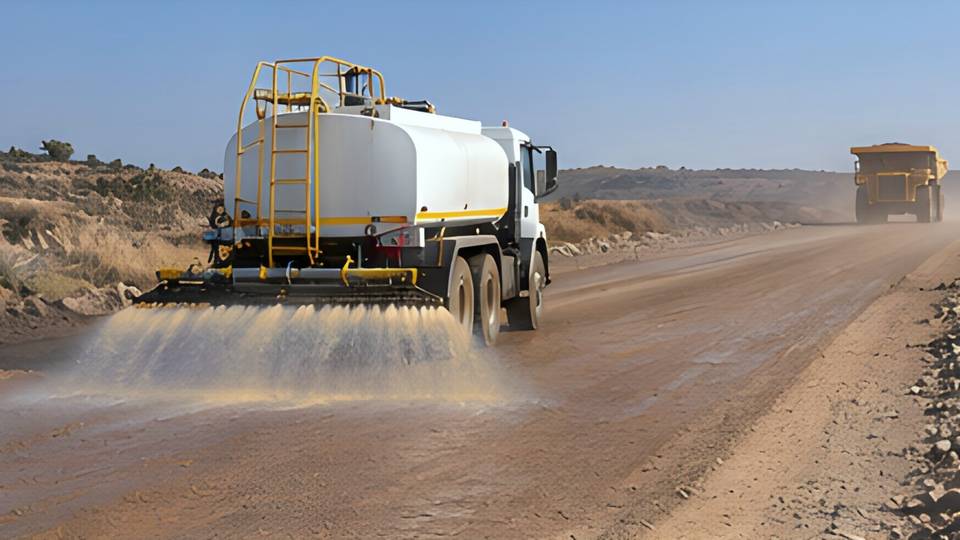
Most dust products go on with equipment a mine already runs. Say how many water carts work the roads and how often they water, where they fill, and what they spray with; for heaps, whether they are wetted by water truck cannons or spray systems; and for a stabiliser, what will mix and compact the layer. Say who applies the product: the mine’s own crews or the company that wins the work. How each of our products goes into a cart: Water cart dust suppression: what to add.
3. Ask for the job, not a brand
Describe what the product must do: hold the water on a road for longer, bind the fines into the surface, carry water into a heap, crust a surface that is left standing, or stabilise a gravel layer. Then ask each offer to name its product, its type (water extender, binder, wetting agent, crusting binder or stabiliser) and the surfaces it is offered for. The types side by side: Dust suppression chemicals: which type does what.
4. Ask for the documents
Ask for the technical data sheet and the safety data sheet of each product offered, and list any other document your tender or vendor system needs. For each of our products, ask which data sheets are available: see Data sheets. For anything else your tender asks for, we tell you what we can send.
5. Packs and delivery
Name the mine or site to deliver to, its country and the date you need the product, and the packs your site can take. Our products come in 200 L drums, 1 000 L flowbins and bulk tankers; Hydrogel and DustBinder Lignin in flowbins and bulk tankers. Deliveries outside South Africa are quoted with each order.
6. Quantities and prices
Give the quantities, or the lengths, widths and areas a supplier needs to work them out, and ask for a price for each line. Prices are quoted with each order, for the buyer’s quantities and delivery site, so a tender that gives the whole scope gets offers that compare.
7. Build in a fair trial
Where a long contract follows, a trial on the mine’s own roads shows which offer works there. Set it up before the trial starts: matched sections, a baseline, both sections over the same weeks, and the water-cart loads counted. How to run one: How to run a fair haul road dust control trial.
A checklist to copy
- Each surface: what it is, its size, its material, its traffic and the climate.
- How the product will go on: water carts, cannons or sprays, mixing and compaction, and who applies it.
- The job the product must do, and the type and product each offer names.
- The technical data sheet and safety data sheet of each product, and any other document your system needs.
- The delivery site, its country, the date and the packs your site can take.
- The quantities, or the sizes to work them out, and a price for each line.
- A fair trial, if a long contract follows.
Sending us a tender or RFQ
Holding an RFQ or tender? Send it whole, and we reply to every line we supply. The form on our contact page takes the tender reference and its closing date, and the e-mail it opens can carry the tender file.
Also searched as: dust suppression specification, dust control specification, dust suppressant RFQ, dust suppression tender, dust suppression scope of work.
Questions
Questions about dust suppression tenders
What should a dust suppression tender include?
Each surface and its size, material, traffic and climate; how the product will go on; the job it must do; the data sheets and any other documents needed; the delivery site, date and packs; the quantities; and, where a long contract follows, a fair trial.
Should a dust suppression tender name a product?
A tender that describes the job lets each supplier offer the product that suits it, and lets the mine compare the offers. Ask each offer to name its product and its type.
Which documents should a dust suppressant offer include?
The technical data sheet and the safety data sheet of each product offered, and any other document the tender or vendor system needs. For each of our products, ask which data sheets are available.
Does 88Chemco reply to part of a dust suppression tender?
Yes. Send the tender whole, to info@88chemco.com or on WhatsApp +27 84 556 8888, and we reply to every line we supply.
Contact
Tell us what you need.
Tell us the product, the quantities, the mine or site and its country, and the date you need it. Holding an RFQ or tender? Send it whole, and we reply to every line we supply.
E-mail info@88chemco.com · WhatsApp +27 84 556 8888 (opens WhatsApp)
Prices and deliveries outside South Africa are quoted with each order.