
Haul roads
Water cart dust suppression: what to add, and how it goes on
Most mines already run water carts. Water alone damps the dust until it dries, so the carts go round again and again. 88Chemco’s dust products use the same carts and water trucks, each in its own way. This guide sets out what goes into the tank, in what order, and what keeps a cart clean between products.
Before you fill a cart, ask us about handling and the protective equipment for each product.
Why water alone keeps the carts busy
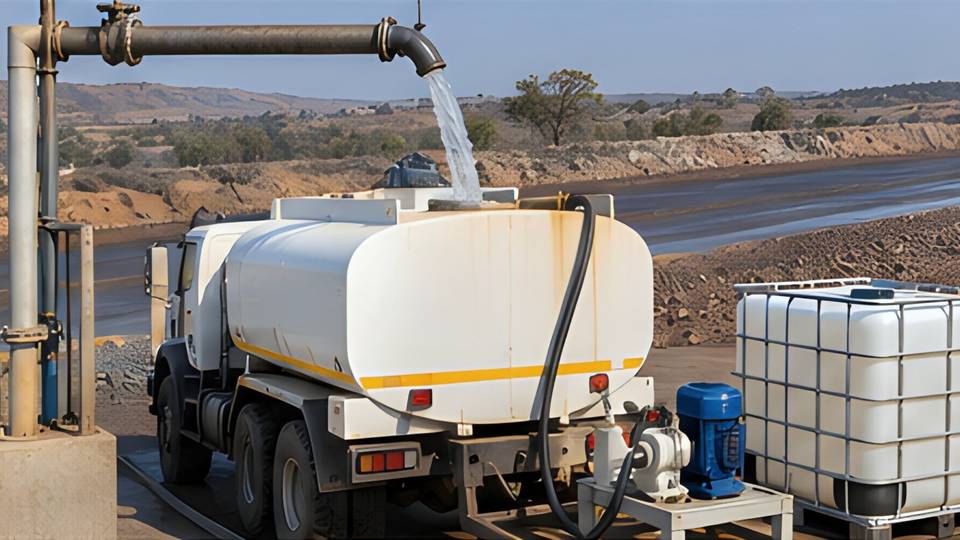
Water sprayed on a gravel road evaporates within hours and has to be put on again and again. A product in the water changes that in one of three ways: a water extender holds the water on the road for longer, a binder holds the fines in the road surface, and a stabiliser goes into the gravel itself. Hydrogel and the DustBinders go on from the water carts a mine already runs; a stabiliser goes in through a water truck too, but also needs mixing and compaction.
Hydrogel: at the fill point
Hydrogel, a polymer-based water extender, is added to the water cart at the fill point:
- by a dosing pump, by a timer-controlled pump, or by hand from 20 L containers;
- then the cart waters the road as usual, with the site’s standard watering practice.
It suits ramps, in-pit roads and roads that change often. We advise the dose for your site: tell us the roads, the water carts and how often they water.
DustBinder Lignin: two ways to use the cart
DustBinder Lignin, a lignin-based road dust binder, is mixed into the water cart and sprayed on, in one of two ways.
Spray only, on a road that is already established
- Sweep off loose material. Do not blade a treated surface.
- Fill the cart with water, then add DustBinder Lignin.
- Spray evenly with the cart’s spray bars, and repeat the application to keep the treated layer.
Establish, then spray
- Prepare the road: sweep off loose material, repair damaged spots and compact the repaired areas.
- Apply DustBinder Lignin neat or diluted with water, depending on what the cart can pump and spray, and repeat to build the treated layer.
- Then keep the road by spraying only. Grade only a section that is being rehabilitated, and establish its surface again.
Either way, spray in dry weather: heavy rain soon after spraying can wash the product out. After use, rinse the cart, pump and spray bars with clean water.
DustBinder Bitumen: a clean cart, product first
DustBinder Bitumen, a proprietary bitumen-based binder for primary haul roads and access roads, goes on by water cart or spray bar with the same method as DustBinder Lignin, with these differences:
- A clean cart. Use a cart, pump and spray bars that are clean and free of other products, DustBinder Lignin included. Never share a cart between the two.
- Product first. Put DustBinder Bitumen in the cart first, then add the water, and keep it circulating.
- Clean dilution water. Dilute only with clean water that is not acidic, and test a small batch first: hard or saline water can make the product separate.
- No aluminium or galvanised containers. Never put DustBinder Bitumen in aluminium or galvanised containers.
- No heating. It goes on at ambient temperature.
- Dry weather. Do not spray when rain is expected, and keep run-off away from drains and watercourses.
- Keep traffic off until the surface has dried and turned black: a freshly sprayed surface is slippery.
CRP88: through the water truck, into the gravel
CRP88, a polymer-based soil stabiliser and dust suppressant for unbound gravel, goes into the material rather than onto it:
- A mix design first sets the rate and the moisture content.
- Fill the water truck with water first, then add CRP88 and mix.
- Spray and mix it into the material in place, with a recycler or a grader, or mix it at a central plant; then compact the layer and let it cure before traffic.
- Rinse the water truck, pump and spray bars with clean water before the product dries.
RoadBinder, for road layers, also goes in through a water truck, with the compaction water: see Haul road stabilisation.
Heaps and dams: cannons, sprays and sprayers
Not every dust source is a road. SuperWetter goes on through water truck cannons or spray systems and carries the water into coal heaps and other dense material heaps. DustSkin is sprayed on by water cart or sprayer and binds the loose surface of ground that is not driven on into a crust: stockpiles, tailings storage facilities, ash dumps and dams, and exposed soil.
Keeping carts apart
- DustBinder Bitumen has a clean cart of its own, never shared with DustBinder Lignin.
- After DustBinder Lignin, rinse the cart, pump and spray bars with clean water.
- After CRP88, rinse them before the product dries.
- Hydrogel goes in at the fill point, and the cart then waters as usual.
What to tell us
- The roads, heaps, dams or layers to treat, and their rough size.
- How many water carts or water trucks work them, and how often they water.
- How the carts are filled, and what they spray with: spray bars, cannons or sprayers.
- The mine or site to deliver to, its country, and the date you need it.
For Hydrogel and the DustBinders, we advise the dose for your site; for CRP88, the mix design sets the rate. To compare the products before you choose, see Dust suppression chemicals: which type does what.
Measure it
The water carts are also the simplest measure. Count the water-cart loads on a treated section and on an untreated one over the same weeks: see How to run a fair haul road dust control trial. For what Hydrogel did on mine haul roads, see Hydrogel field trials.
Also searched as: water cart dust suppression, water truck dust control, dust suppression water truck, water bowser dust suppression, water tanker dust suppression.
Contact
Tell us what you need.
Tell us the product, the quantities, the mine or site and its country, and the date you need it. Holding an RFQ or tender? Send it whole, and we reply to every line we supply.
E-mail info@88chemco.com · WhatsApp +27 84 556 8888 (opens WhatsApp)
Prices and deliveries outside South Africa are quoted with each order.